Swords in +1 Forge Blade Loot: Verified Forge Outcomes and Shape Odds
+1 Forge Blade Loot swords are rolled, player-forged variants. See verified outcomes with real stats, the forge's shape odds, and which choices change results.
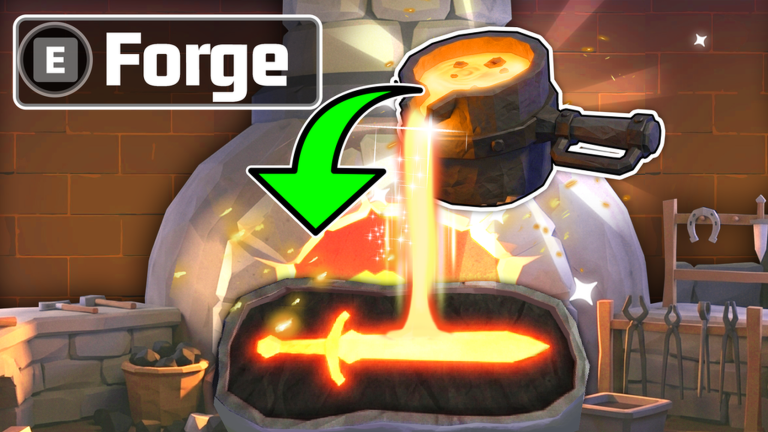
Every sword in +1 Forge Blade Loot is one you forge yourself, and the forge rolls what you get. No stable list of named swords is documented in the game's screens: you draw the blade, the tier is rolled, and even duplicates of the same sword can come out with different stats. What you can list reliably are the outcomes players have actually pulled and the shape chances the forge UI displays — both collected below.
What a "+1 Forge Blade Loot sword list" can honestly contain
The forge produces player-created variants, not fixed database entries:
- You draw how the sword will look before forging, and a crooked drawing "will end up crooked."
- The tier is rolled — "put it in to roll for the class" — up a ladder of rarity classes.
- Names are not a reliable key. One detailed playthrough notes "this map doesn't even show the names" and identifies swords by shape and tier; a duplicate of the same massive sword re-forged later came out with higher damage (25 million), and in another recording the same sword model showed 18,000 and 17,000 power while a re-forged copy gave only 12,000.
- A name-style label can still appear on a result screen — one drawn sword was labeled "Sword of faith" — so generated names exist at the forge even though no stable catalogue is documented.
The developer description, "Shape & Forge Your Own Sword," matches that picture. Treat any sword list for this game as a snapshot of rolled outcomes, not a lookup of guaranteed swords.
Verified forged swords and their stats
These outcomes were read directly on screen from the forge-result screen and the weapons menu. All are single-session observations, and the two recordings even label tiers differently (one roll shows common, rare, epic, legendary, secret, mythical; the other displays Uncommon/Rare/Epic/Legendary/Mystic/Secret plus Special and Challenge), so treat each row as observed once, not as fixed data.
| Tier | Outcome as identified on screen | Observed properties |
|---|---|---|
| Uncommon | First forge test sword | Power 8, Attack Speed 2.2, with damage and value |
| Mystic | Rolled sword from a high-luck ore mix (not the katana the player hoped for) | 2,200 damage; two skills, one with a 9-second cooldown dealing up to 400% damage; power training rose to 284,000 per session |
| Mystic | Mystic sword | 10 million power, displayed as 14 million later the same session (cause unexplained) |
| Challenge | Sharp Katana | 193 million damage; price over 65 billion |
| Special | Short sword roll (came out huge despite the name) | 210 million damage; price 85 billion; 295 million after equipping an attack +50% rune |
| Rolled; ladder shown as common → mythical | Drawn sword labeled "Sword of faith" | Power, attack speed, attributes and critical; cost 2.9 billion |
Two limits matter when comparing these rows. The strongest referenced sword — a greatsword resembling the "GR Source" — was never obtained on record, so nothing here is a verified best or ultimate sword. And stat values are not fixed per design: the same sword model produced different power readings, which is exactly why the game gives you inspection tools rather than a fixed stat sheet.
Where to check a sword's real stats
Open the weapons menu: it lists every forged sword (and shields, once crafted) with power values, so comparing a fresh roll against your equipped sword takes seconds. A sword's own page shows tier, damage, price, attack speed, attributes and critical, with skills listed per effect — for example, one skill listed a 9-second cooldown and up to 400% damage. Rune slots show equipped runes and their stat changes. Unused swords are sold from the same weapons area for money (one sale returned 20 billion) that feeds back into upgrades — see +1 Forge Blade Loot coins.
Shape outcomes the forge displays
Forging a sword — or a shield, which shares the forge's weapon/shield category choice — requires at least three ores, and the forge shows a percentage for each sword shape before you commit:
| Shape | Observed chance | Conditions |
|---|---|---|
| Short sword | 25% | With 3 Mystic-tier ores in the forge |
| Long sword | 50% | With 3 Mystic-tier ores |
| Katana | 20–25% | Stayed 20% even with the highest Mystic ore (7,000 luck multiplier), no matter how much ore was added; four of one ore raised it to 25% |
| Greatsword-type "GR Source" | 0% → 22% → 24% | 0% with 3 ores; no increase at 4 ores; 22% at 6 ores and 24% at 7 ores (a second session saw the chance appear at 5 ores, 24% at 6 and 25% at 7) |
The tiny greatsword and katana percentages are why players read those shapes as the valuable rolls — the low odds are the point. One naming caution: subtitles spell the greatsword variously as "GR Source," "Grass source" and "Grimoire Source," so the huge greatsword shape is the reliable identifier, and its strongest version was never forged on record.
Which forging choices actually change results
Only some output differences trace to choices you make.
Tested effects:
- Each ore displays its own luck multiplier, even within the same tier — 14x vs 11.5x on same-tier ores, with Crystal the lowest observed at 10.5x, and Mystic-tier ore luck values from 2,000 up to 7,000.
- The displayed total responds to ore swaps: removing one ore dropped a total to 4,800.
- Mixing weak ores with strong ones pulls the multiplier toward the middle — a 13.1717x setup fell to 3,900 when lesser ores went in.
- Ore count moves shape chances: the greatsword went 22% → 24% from 6 to 7 ores, while the katana stayed at 20–25% regardless.
- Drawing accuracy carries into the finished blade: "if you make it crooked, it will end up crooked."
- Ore tooltips state sword-relevant effects before forging: increases power (7,000 / 6,500 / 5,000 observed), improves weapon quality, improves weapon stats, grants an extra rune slot, grants extra attributes, unlocks traits; one dragon scale read "increases attack power by 4,000, grants two extra attributes, unlocks ice attributes." These are tooltip promises — the recordings never tied them to a finished sword's verified attributes.
Unexplained in testing:
- A duplicate of an already-obtained massive sword came out with higher damage, with nothing on screen showing why.
- A Mystic sword displayed 10 million power, then 14 million; the player suspected a rebirth link ("maybe it's because I reborned") but wasn't sure.
- Runes behaved inconsistently: an Epic +30% damage rune left a 193-million-damage sword unchanged, while an attack +50% rune raised a different sword from 210 to 295 million.
- Tier stays a roll no matter the luck: four 6,000x-luck ores still produced Uncommon, Rare and Common shields, with the forge displaying Epic 3%, Legend 1% and Mystic 1% chances.
The practical upshot: pick your highest-multiplier ores, add enough of them to raise the shape you want, and draw carefully — then accept the roll, because no ore combination shown guarantees a tier or shape.
From outcome to process
This page covers what comes out of the forge. How a sword is produced step by step — the ore minimum, drawing the shape, hitting the blade and the final forging phase — is covered in the +1 Forge Blade Loot sword forging guide.
Related Guides
Ultimate Sword Goal
Understand what the advertised Ultimate Sword goal really is and compare real sword stats as you repeat the forge loop.
Sword Shaping
Trace the forge design steadily to draw your blade; crooked lines stay crooked before the final hit rolls rarity and stats.
Monster Drops
Ore tiers with luck values, stage loot for dungeon stages 1-21, and which monsters drop which materials.
How to Unlock Traits
Forge with the right ores to unlock Traits: confirmed steps, what the unlock costs, and how to check it worked.